
Developer interview · Part 6 of 12Data and daily state
What are Dao Years, Realm and Spirit Root in Data2Dao? Why sleep counts
Dao Years are the long-term total of your practice in Data2Dao: 30% is credited right after a session and the other 70% depends on that night's sleep. With enough Dao Years your Realm goes up. Spirit Root is a five-element profile that forms after about a month of use. This post explains the rules for all three and the developer's reasons for the design.
Short answer
Dao Years are the long-term total of your practice. Clearing a stage, meditating and sleeping well all add to them, and with enough Dao Years your Realm goes up. After you finish a stage, 30% is credited first and the other 70% depends on that night's sleep: with at least 7 hours it is credited in full, and with less than 5 hours it dissipates. Spirit Root takes about a month of use to form. It is a profile of your constitution and behavioral tendencies, in five types: Metal, Wood, Water, Fire and Earth.
Key points
| Term | What it is | Rules |
|---|---|---|
| Dao Years | The long-term total of your practice | 30% is credited after a session and 70% depends on that night's sleep; with at least 7 hours it is credited in full, with less than 5 hours it dissipates |
| Realm | The level you rise to once Dao Years reach a threshold | Twelve Realms, nine tiers in each |
| Spirit Root | A profile of your constitution and behavioral tendencies | Unlocks after about a month of use; it is among the six metrics on the home screen and shows "Sensing" at first |
- The twelve Realms, in order: Awakening, Gathering, Qi Refining, Foundation, Meridian, Core, Nascent, Spirit Transformation, Void, Union, Tribulation, Immortal.
- The five-element Spirit Roots: Metal is strength and precision, Wood is regularity and consistency, Water is rest and recovery, Fire is intensity and explosive effort, Earth is everyday accumulation.
- How the app describes Spirit Root: it reflects your physical capacity, meaning trends in training adaptation and recovery; it is not a body age, a medical diagnosis or a lifespan prediction.
How Dao Years grow
How do Dao Years grow? Do they grow faster the more I practice?
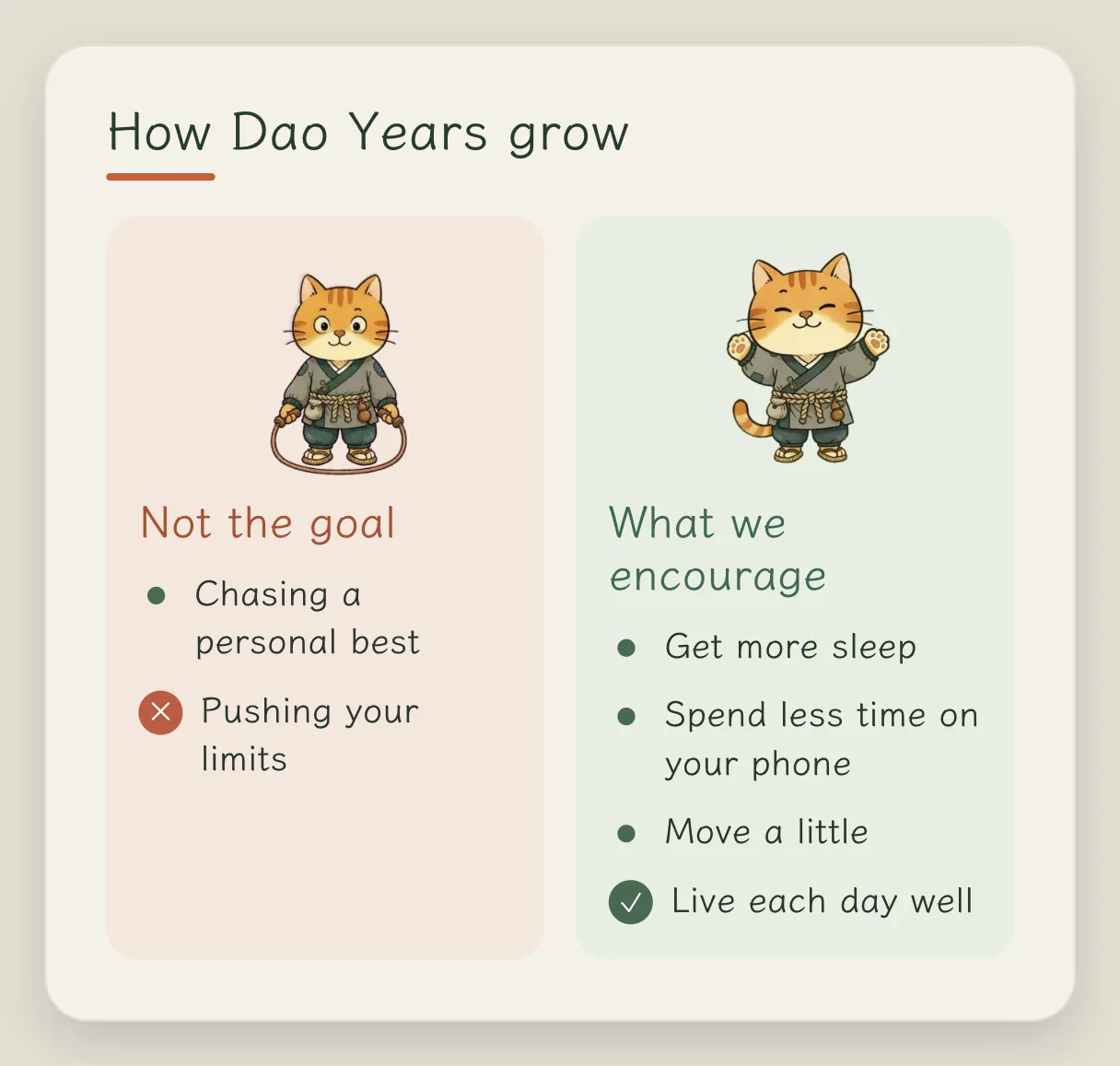
Broadly, yes. But what I want to encourage more is sticking with it: sleep more, spend less time on your phone, and practice a little every day.
Some sports watches are built around pushing you to surpass yourself and set new personal bests. We don't chase breaking limits. Xianxia (cultivation) novels talk about breaking limits all the time, but for us, living each day well and on a regular rhythm is already pretty extreme. Do what you are supposed to do each day, and your Dao Years grow and your Realm rises.
Why does the EXP from a session also depend on how well you sleep that night?
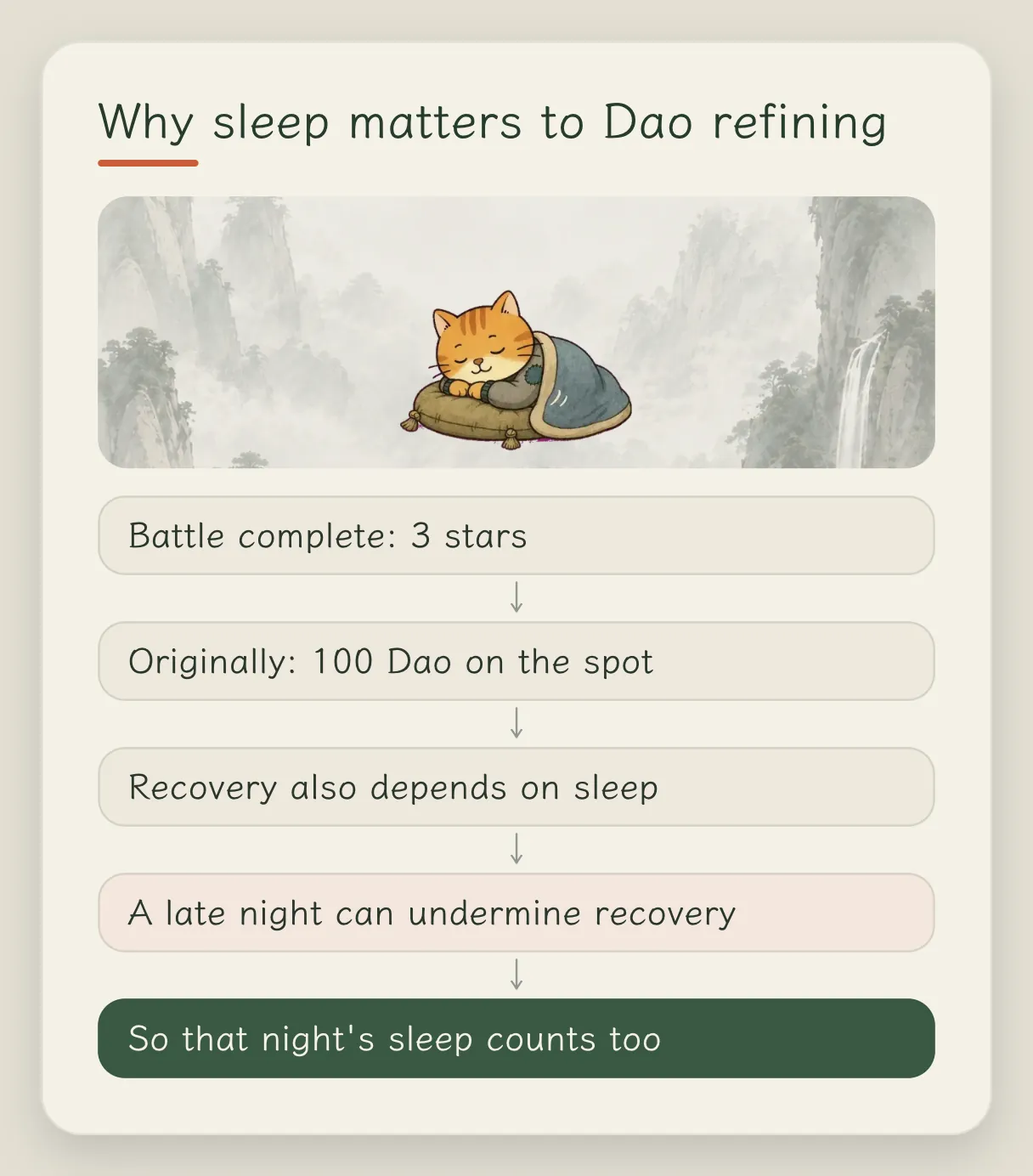
The earliest design was that you finished a stage with a full three stars and got 100 EXP on the spot. Later I felt that was wrong. After practice your body relies on sleep to recover, especially after things like running or ball games that last half an hour to two hours. If you then stay up late that night, to my mind that does real harm. So I counted that night's sleep in as well.
What Spirit Root is
Do newcomers have to understand Spirit Root before they can start?
No. Spirit Root stands for your constitution, a bit like the "body age" in some fitness bands. But the cultivation system already has Dao Years, as in "I have five hundred Dao Years", and putting "body age: 25" next to that would be confusing, so body age has been left out for now.
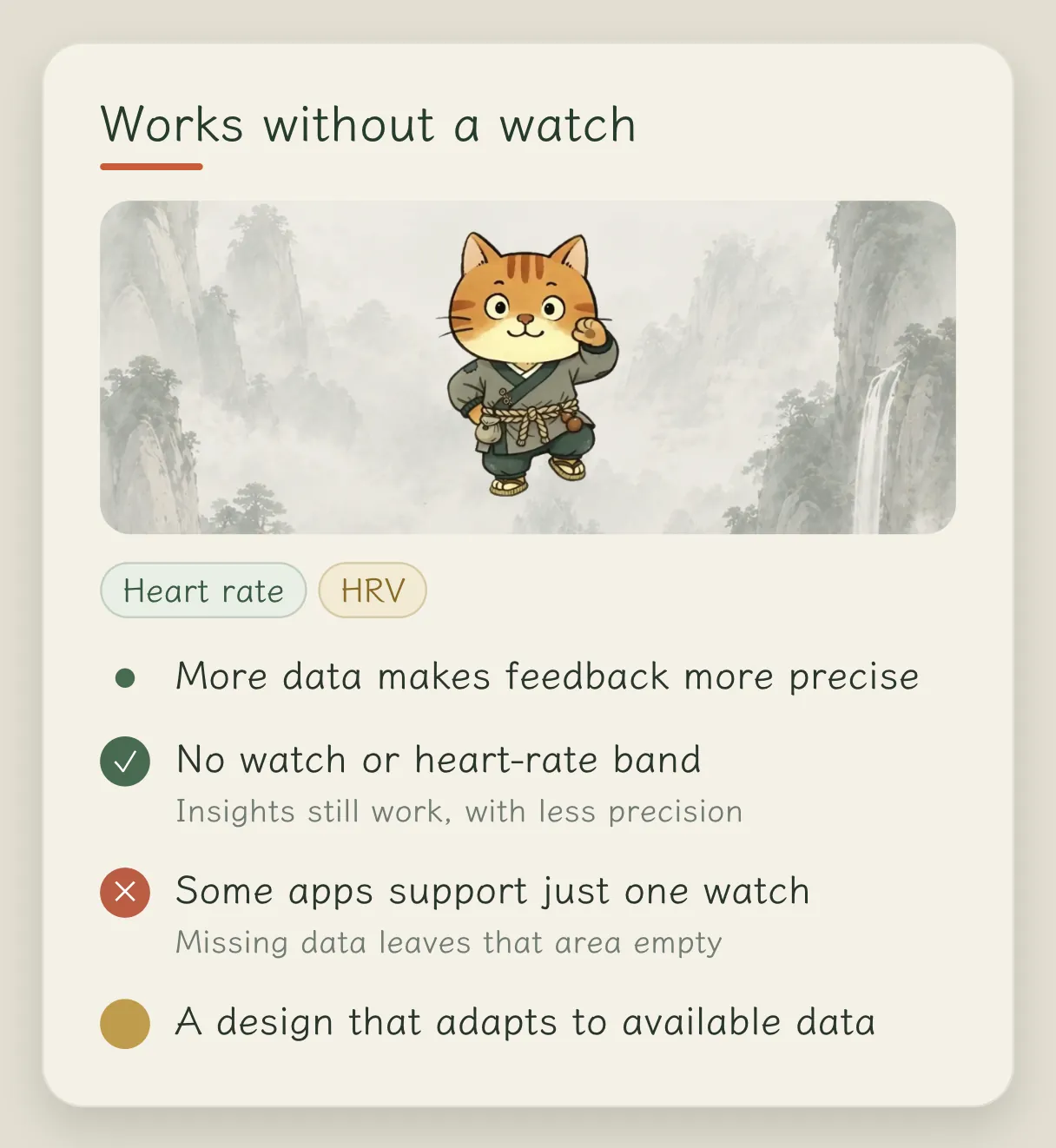
The other consideration is that I don't know how many users have heart rate and HRV data. So all the data insights are built to be compatible: the more complete the data, the more accurate the feedback. Without a watch or a heart rate band you can still use the full insights, they are just less accurate.
There is one situation I personally can't stand: some apps only recognize one kind of watch, and if you switch brands they can't get the data, so a big chunk of the screen is just empty. That is why I made it a stepped design.
How does Spirit Root form? Is it different for everyone?
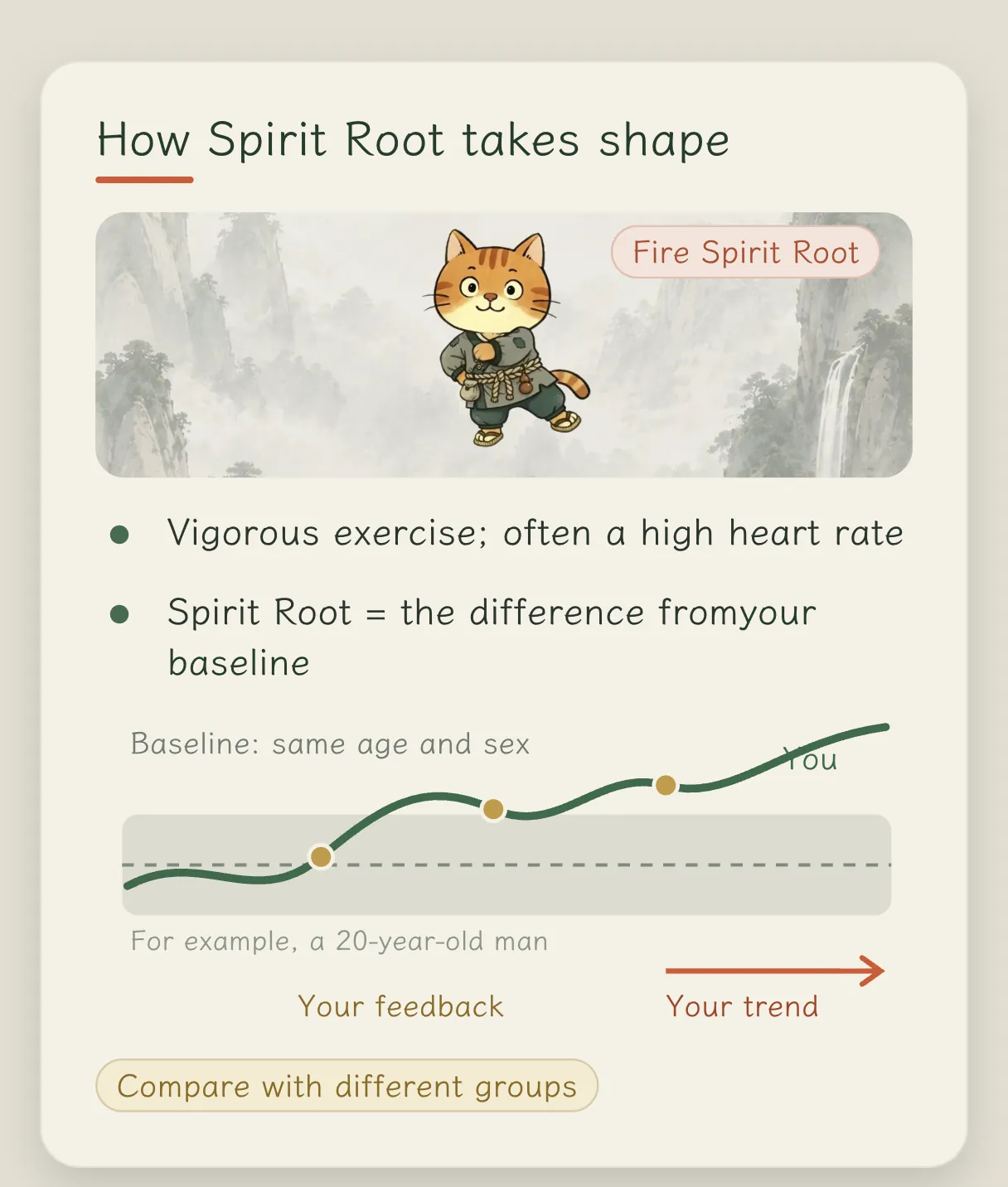
It is different. For example, if you often do intense exercise and your heart rate is frequently high, you may be a fiery, always-on-the-go Fire Spirit Root.
What it looks at is the gap between you and a physical baseline. The baseline is set by age and sex, for example roughly what level of sleep and exercise capacity a 20-year-old man has. Add your feedback over a period of time and some physical assessments, and you can see the trend moving up and down.
Where can I see my Spirit Root?
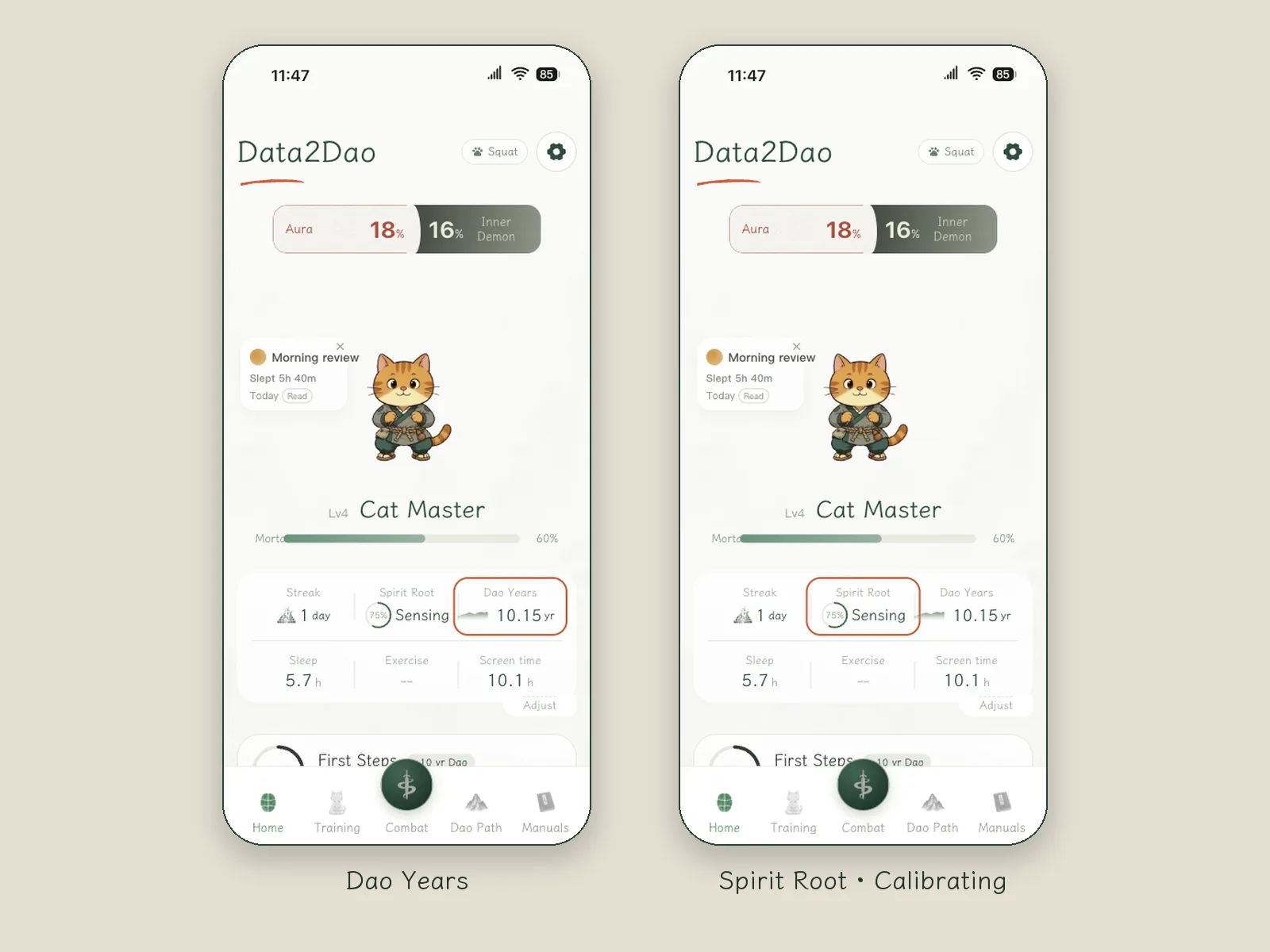
It is among the six metrics on the home screen. It is not especially prominent, and you can tap it open. At first it shows "Sensing", and it takes a while of use before there is a result. Tap in and you see items such as Capacity, Recovery and Practice Rhythm, and further down, how it formed and the trend of each attribute.
FAQ
Why aren't all the Dao Years credited right after a session?
Because the developer considers how well you sleep that night to be part of the session too. After a session, 30% is credited first and the other 70% depends on that night's sleep: with at least 7 hours it is credited in full, and with less than 5 hours it dissipates.
How long does it take for Spirit Root to appear?
About a month. Until then, the home screen shows it as "Sensing".
Does the app have a "body age"?
No. The developer considered it, but because the cultivation system already has Dao Years, adding a body age would be confusing, so it was left out. The app also states that Spirit Root is not a body age.
Do higher Dao Years mean I have been training harder?
Not necessarily. The developer does not encourage breaking limits. Dao Years put more weight on regularity: sleep more, spend less time on your phone, and practice a little every day.
Related articles
Done reading? Stand up for three minutes
Prop your iPhone up and follow the cat for a few moves. Free to download; the annual plan includes a 7-day free trial.